

Whatever the cost
March 5, 2026
Last night, 8:45 p.m., I was squinting at tiny maca seeds, tweezers in hand, racing to plant them by the light of LED shop lights. To protect my sleep, I go to some length to avoid bright blue-hued lights in the evening. I’ll pre-make the baby’s bottle and put it in the top left shelf in the fridge so that if he needs a snack in the middle of the night I can shield my eyes while I feel for it. Last night, I asked the retinas to take one for the team. I was on a mission to start my spring greenhouse.
I discovered maca root powder about a decade ago. Warming, butterscotch-like flavor that nicely thickens a milky tea. Aunt Merry made me a drink that pepped up my energy without caffeine. I got curious—could I grow it?
Black maca grows at 11,000–14,500 feet in the Peruvian Andes. It’s comfortable with freezing but craves daily sun. So slow, weeds around here would eat it alive. Verdict: pipe dream. I gave up trying to grow maca, rhodiola, a dozen other powders and tinctures I was paying high dollar for at the co-op. I grew what I considered pragmatic vegetables: direct-seed crops (kale, lettuce, beets, parsnips), plus greenhouse plants I’d buy in six-packs—tomatoes, peppers, basil.
Then come this winter, maca was on my mind again, and a thought landed that felt larger than maca: Tristan, this is the problem. You're saying no to hard things. Just try growing it. Yeah, it's hard. Just see if you can do it.
This February marks Year 2 of turning my woodshop into a greenhouse. It’s the second year I’m starting maca and rhodiola, and I’m trying again this year to grow the mascot of them all: Rapunzel.
What changed? Last winter, swimming in the usual darkness, I was peeling open seed catalogs for some hope. I found this in the JL Hudson catalog:
“‘RAPUNZEL’, ‘RAMPION’. Sky blue ¾" bells in summer. Hardy biennial to 3 feet. Eurasia. Zone 4. The young roots are eaten raw or cooked, and the leaves and flowers are good in salads. This is the famous plant featured in the fairy tale ‘Rapunzel,’ involving the theft of rapunzels from a witch’s garden. There were formerly cultivated varieties with large roots, but these are extinct, and an interesting project would be reselection. Germinates in a week.”
When I was a kid we had a dairy cow named Hyacinth, a sweet Jersey cow named for the spring bulb. To the extent I had any awareness that Rapunzel the maiden was named for a flowering plant, I figured it was like that—a pretty name.
There’s more to it, I found. The Grimm brothers’ 1812 tale captures something extraordinary: the connection between a pregnant woman, her husband, and a cottage garden plant.
One day the woman saw the most beautiful rapunzel in a bed. “If I do not get some rapunzel from that garden, I shall die,” she said. The man loved her dearly and decided to get her some, whatever the cost. That evening he climbed over the high wall, and hastily took a bunch of rapunzel.
His wife made a salad and devoured it greedily. It tasted so good that by the next day her desire had grown threefold. Once again the man climbed into the garden. To his horror, the fairy was standing there. The man excused himself with his wife’s pregnancy. “It would be dangerous to deny her craving,” he pleaded.
"I will accept your excuse,” the fairy replied. “You can take as much rapunzel as you want, if you give me the child."
In his fear the man agreed to everything. When the woman gave birth, the fairy appeared, named the little girl Rapunzel, and took her away.
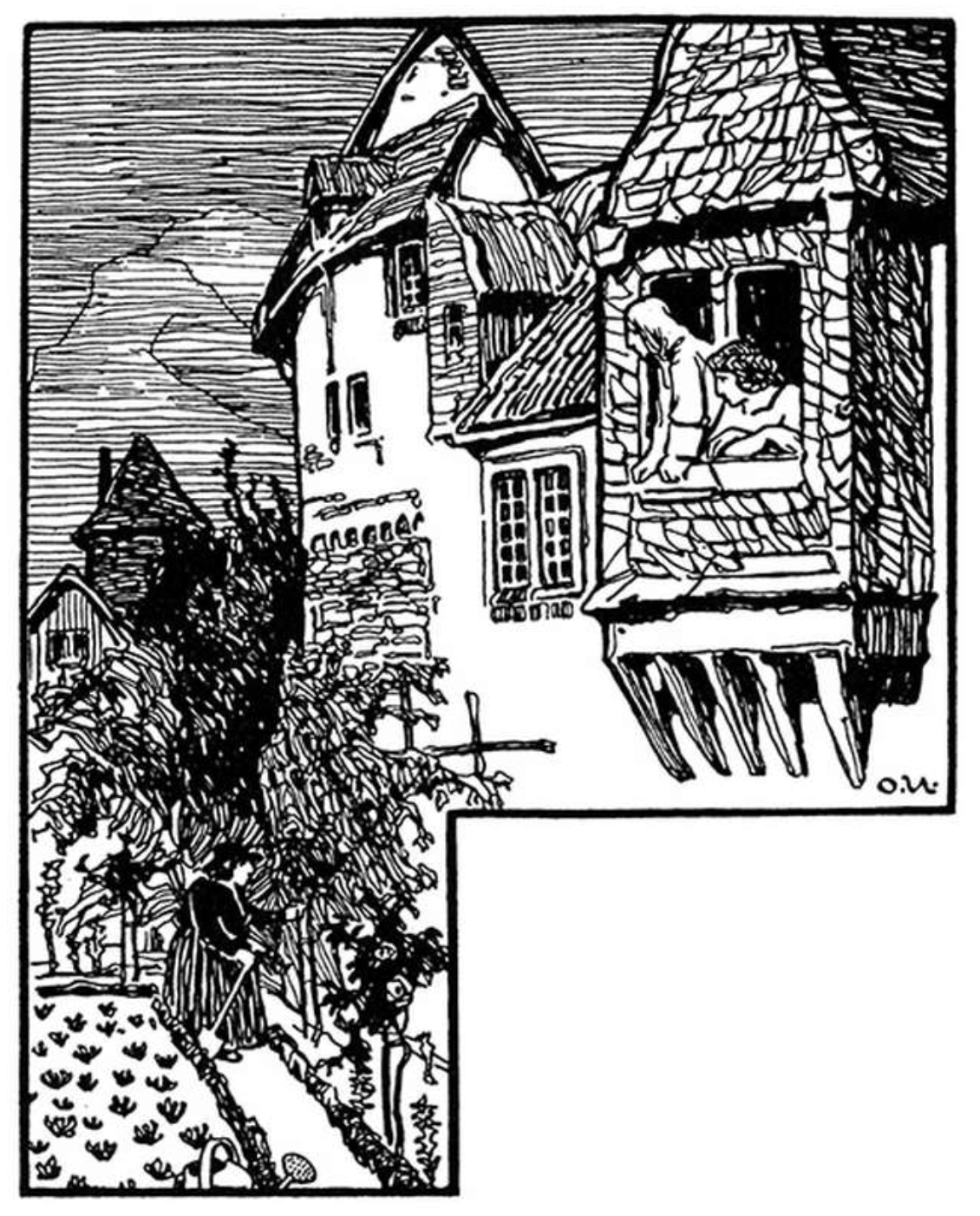
Otto Ubbelohde (1867-1922), German painter and illustrator from Marburg is one of rare artists who decided to portray the scene where the pair is watching Frau Gotha tend her rapunzel.
When my first wife was pregnant we drove one day through some road construction. “Steamrollers,” I pointed. Instant craving: “Steamy rolls. I want steamy rolls,” she said. And if I had to break into a bread factory then and there to satisfy that for her—well, that’s why my son is named Pillsbury.
He’s not, but pregnancy cravings are amazing. They express our innate wisdom and the weird agency of our bodies to bid us obtain things at whatever cost. Well, drugs. People go to crazy lengths to obtain drugs. But Rapunzel is a salad plant! And no question, the husband had to climb that wall for it.
There I was, often bottle-feeding my six-month-old son to sleep by the woodstove, reading about this stolen plant, and I wanted that garden. Alison pumped for nine months and was often exhausted going to work in the morning. I was cooking three meals a day for us both, and that food was feeding our infant.
The pregnant woman didn’t crave just any salad. She craved Rapunzel specifically. Her body knew what it needed. The fairy had that plant in her garden—along with “herbs of all kinds,” as the tale says. Not a monoculture. Not industrial agriculture optimized for yield. A diverse garden where the right plant was there when a pregnant or nursing woman needed it.
I ordered Rapunzel seeds last spring. They’re supposed to be easy to direct seed. “Germinates in a week,” the catalog promised. The seeds are tiny—far tinier than carrot seeds. I broadcast them into two beds I’d prepared. Nothing came up. Not one seedling. My rocky soil, the weeds, last July’s drought—the seeds didn’t stand a chance.
This year I’m starting them in flats under lights. Controlled moisture, weed-free soil. Same with the maca and rhodiola. Seed-starting isn’t as hard as I’d feared.
I have a pessimism about seeds that leads to great delight. I never expect them to sprout, so when they do each one feels like a miracle. Watching those seeds sprout, I wanted that garden more and more. Then I noticed whose garden it was I wanted.
I’m growing the garden of the supposed villain, Frau Gotha. Depending on which version of the tale you read—and it transformed a lot over the centuries—Gotha is either a “fairy” or an “evil sorceress,” but she derives her power from plants and magical arts. In the oldest versions, she’s simply called “the fairy” and her garden is full of “herbs of all kinds."
I’m tired of the “superfood” storyline. Guess what—plants are good for you! When I take a supplement, I’m getting isolated nutrients from one plant. That’s a start. What I’m hungering for is the relationship. I want to encounter them as real plants, as real as the husband encountered the fairy, Frau Gotha, standing in that garden.
Frau Gotha knew which plants a pregnant woman would crave. She kept a diverse garden where the right plant was there when needed. That’s not evil. That’s women’s knowledge about plants and healing. And we turned her into a villain.
Last night at 8:45, planting under those LED lights, studying the germination needs of each seed, I was answering that same call—the one that made the husband climb the wall, whatever the cost.